Schedule
From 9:00 am to 8:30 pm
Last entry: 7:00 pm
Rates
- Adult29,00€
- Junior (12-17 years)12,50€
- Children (under 12 years)Free
Visit Casa Mila (La Pedrera) and you will enter the world of Antoni Gaudí and discover for yourself how nature is the origin and inspiration of the building.
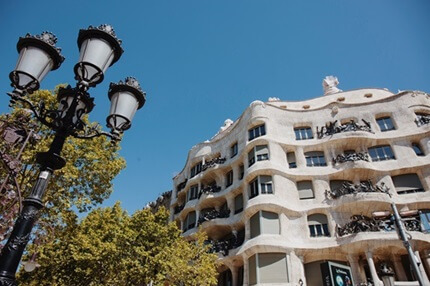
Casa Milà, popularly known as La Pedrera, is a UNESCO World Heritage Site and the architect’s last civic architectural project. It is a unique building, a masterpiece of nature that reveals Gaudi’s boundless imagination.
La Pedrera is also the only Gaudi interpretation centre in Barcelona and is an essential place to visit in order to learn about the architect’s entire body of work and his inspiration. In total, you will tour 4,500 square metres divided across five floors. On this tour you will be able to discover for yourself during the day all the parts of the building open to visitors.
5 reasons to visit:
- Gaudí's last residential building, with his most spectacular building, technical and decorative innovations.
- The most spectacular, and popular, rooftop terrace in Barcelona.
- The first building in Spain to be named a UNESCO World Heritage Site, in 1984.
- The only building where Gaudí created two huge courtyards.
- Amazing murals on the walls of the courtyards and main staircase.
The organization can change the itinerary of the visit


What will you see?
The façade
An architectural sculpture
.jpg)
.jpg)
.jpg)
Warrior Rooftop
A unique achievement that defies classification
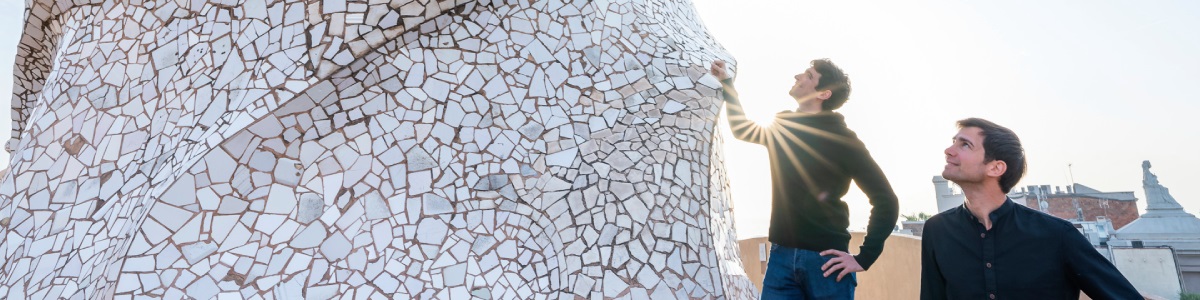
The Milà House terrace is a Barcelona icon from where you can see spectacular 360º views of the city. The chimneys stand in hierarchical lines of warriors turned to stone. Guardians of the building since time immemorial, they come to life to tell us about the origin of the building. And the stairwell covers emerge as ancient forces of nature: earth, air, fire and water...
.jpg)
.jpg)
.jpg)
The Whale Attic
Discover Gaudí in a magical space
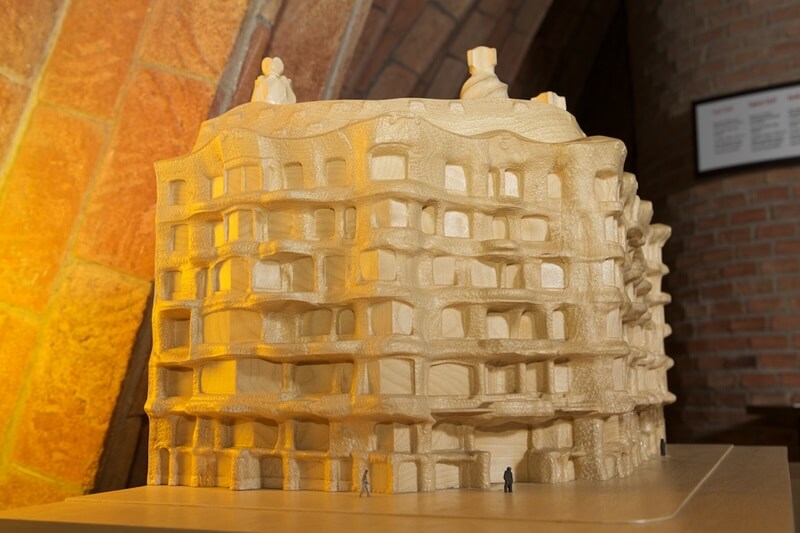
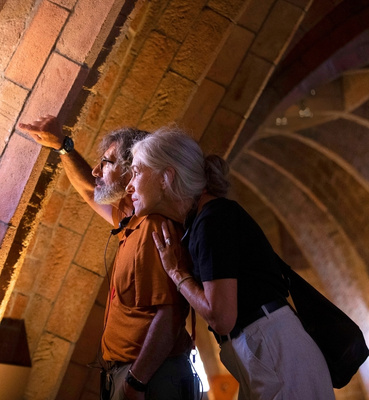
The attic of the Milà House has more character than any other space in all Gaudí’s architecture. To enter it is to enter a great living being, breathing and welcoming us. Once more there is a clear reference to nature, represented by 270 catenary arches recalling the skeleton of a whale. But this magical space also houses the only exhibition devoted to Gaudí and all his work (Gaudí Exhibition). Here, through audiovisuals, models, drawings, objects and designs, you can discover the most extraordinary features of his architecture and the keys to his genius.
.jpg)
 (1).jpg)
.png)
The Tenants’ Apartment
Life a hundred years ago
Situated on the fourth storey above the main floor, this apartment shows how a bourgeois family in Barcelona lived in the opening 30 years or so of the 20th century. With an ambience recreated using furnishings and household equipment and utensils of the time, the apartment enables you to see how the interior was distributed, as well as the decorative features Gaudi designed such as knobs, mouldings, doors, floor surfaces and handles.
_0.jpg)
_0.jpg)
_0.jpg)
The Flower Courtyard
In full colour
The walls of the Flower Courtyard, in Passeig de Gràcia, are a real spectacle of shapes, light and colours contrasting with the sober facade. The colour is provided by the wall paintings decorating it, mostly with floral motifs. Hundreds of flowers come to life on the ceiling of the spectacular staircase that climbs up to the main floor like a winding root.
.jpg)
.jpg)
.jpg)
The Butterfly Courtyard
Living nature
At the Milà House, the Butterfly Courtyard, which leads off Carrer Provença is a place where everything comes to life. It lives; it breathes, and fantastic creatives live there. The outstanding feature is a huge butterfly that has settled on the lintel between inside and the street. Higher up, enveloping the staircase that leads to the main floor, another butterfly, or some kind of fantastic insect, is resting. A huge insect wing takes flight, perpetually turning a thousand different colours.
.jpg)
.jpg)
La Pedrera Accessible
The Catalunya La Pedrera Foundation facilitates accessibility at La Pedrera by offering various tours and services adapted for physical, sensory, and cognitive accessibility, ensuring all visitors can enjoy and understand the building and its content.
The La Pedrera video guide, included in the admission price, is available in: Catalan, Spanish, English, Chinese, French, German, Portuguese, Italian, Russian, Japanese, and Korean. Moreover, it incorporates resources in Catalan Sign Language (LSC) and Spanish Sign Language (LSE), transcripts of audio information, and the visit with audio description in Catalan, Spanish, and English. It also includes a simplified version for Easy Reading.
Groups
If you're a group of more than nine (9) people and want to visit La Pedrera, you have to book ahead here. Occupancy for groups is limited and the bookings have to be processed by our Groups Department, which will make sure you get a faster, more personalised response.
 (1).jpg)
Optional: Culture and gastronomy come together to complete your visit.
With an exclusive breakfast, a gourmet brunch, or an unforgettable dinner, enhance your La Pedrera experience in the most delicious way.
After exploring the building and being amazed by its architecture, continue at our iconic restaurant, where culture and cuisine blend in a unique setting. Three carefully crafted proposals combining tradition, creativity, and flavor await you to keep enjoying with all five senses.
.jpg)
_0.png)