

 Español
 Català
 Français
 Italiano
 Portuguese
 Deutsch
 中文
 한국어
 日本語

Discover one of Gaudí’s greatest masterpieces.
Palau de la Música Catalana
Lluís Domènech i Montaner (1849–1923), architect, historian, politician and intellectual, is one of the most prominent figures of Catalan Modernism. In 1905, he was commissioned to design the new headquarters for the Orfeó Català choral society, a building intended to host the organisation’s activities as well as a large concert hall. The result was the Palau de la Música Catalana, a masterpiece of Modernist architecture, the only concert hall built entirely in this style, and one of Barcelona’s most iconic heritage landmarks.
Year of construction
1905–1908
Location
Carrer Palau de la Música, 4-6, 08003 Barcelona
History of the Palau de la Música Catalana
The Orfeó Català, a choral society founded in 1891 by Lluís Millet and Amadeu Vives, was born out of a desire to promote and disseminate the Catalan choral repertoire. From its beginnings, it established itself as one of Catalonia’s foremost musical institutions and made a decisive contribution to championing Catalan music and musical heritage.
Funded by public subscription, the Palau was destined to be far more than just the headquarters of the Orfeó. Conceived as a major cultural venue open to the city, it was created to host symphonic concerts, choral performances and other musical events, strengthening Barcelona’s standing as a leading cultural capital.
Domènech i Montaner and the construction of the Palau
Construction was shaped by a plot of modest dimensions on Carrer d’Amadeu Vives. To overcome this constraint, Domènech i Montaner devised an innovative architectural solution based on a metal framework that optimised the available space, provided seating for over two thousand spectators and allowed large glazed surfaces across the façades.
The façade of the Palau de la Música Catalana: sculptures and mosaics
The exterior is dominated by the sculptural group Catalan Popular Song, by Miquel Blay, regarded as one of the finest examples of Modernista sculpture. The façade is completed by broad arches supported by exposed brick and ceramic columns, the balcony adorned with fourteen mosaic-clad pillars, and busts of Palestrina, Bach, Beethoven and Wagner, crafted by Eusebi Arnau. Crowned at the top, a grand mosaic by Lluís Bru and Antoni Maria Gallissà portrays the banner of the Orfeó Català and incorporates an allegory of La Balanguera, a poem by Joan Alcover set to music by Amadeu Vives.
Inside the Palau: the stained-glass skylight and the concert hall
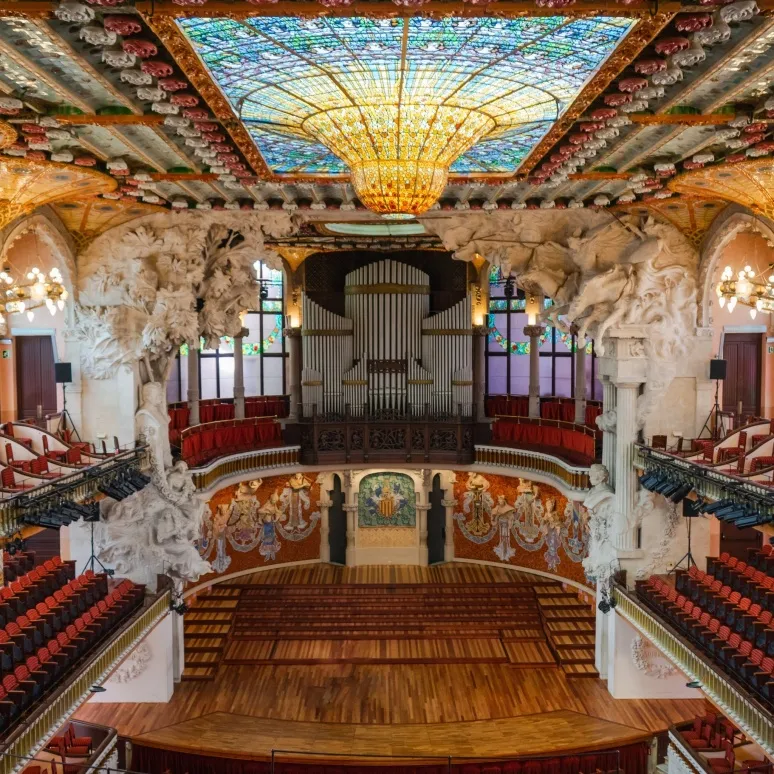
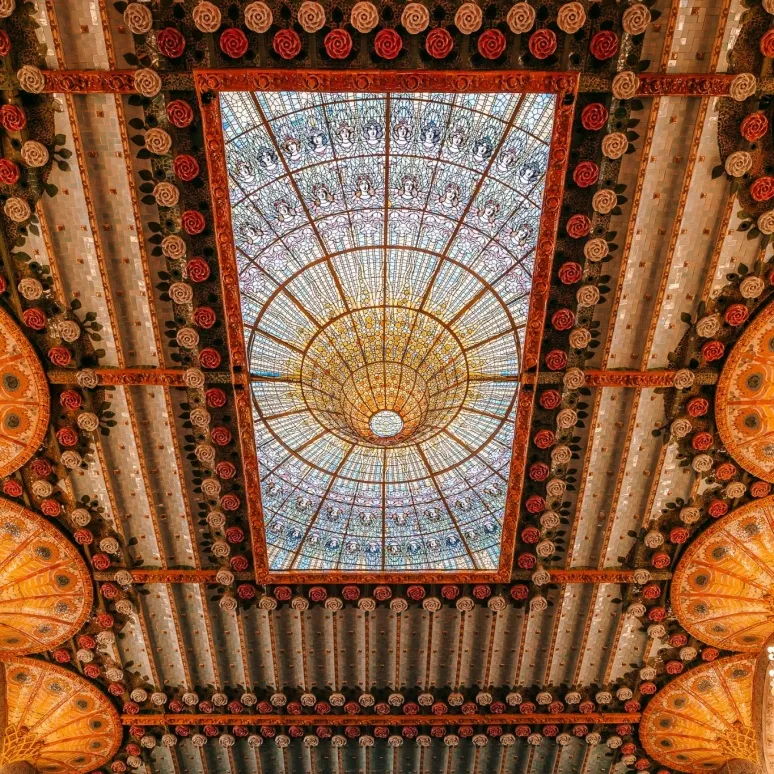
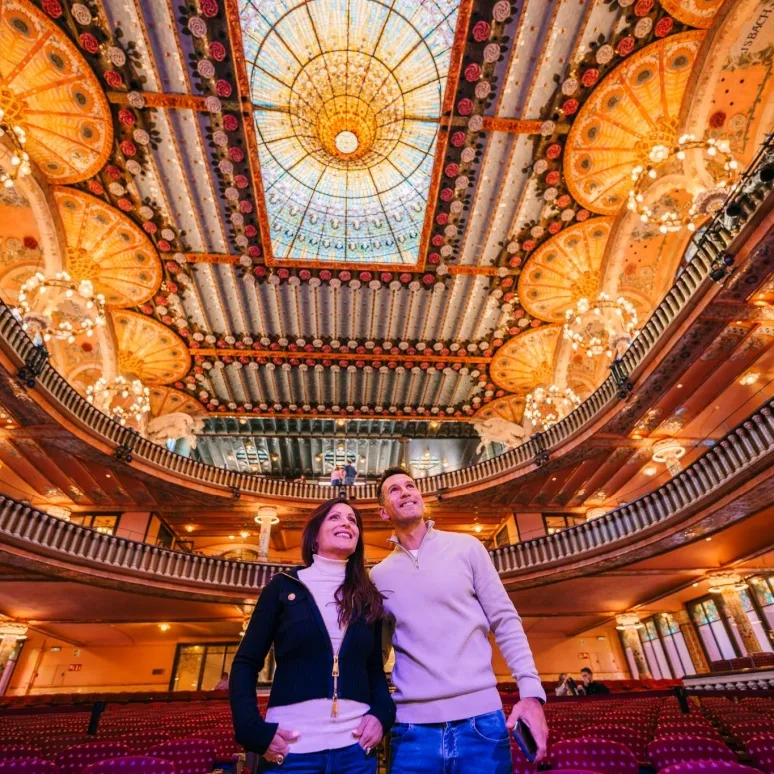
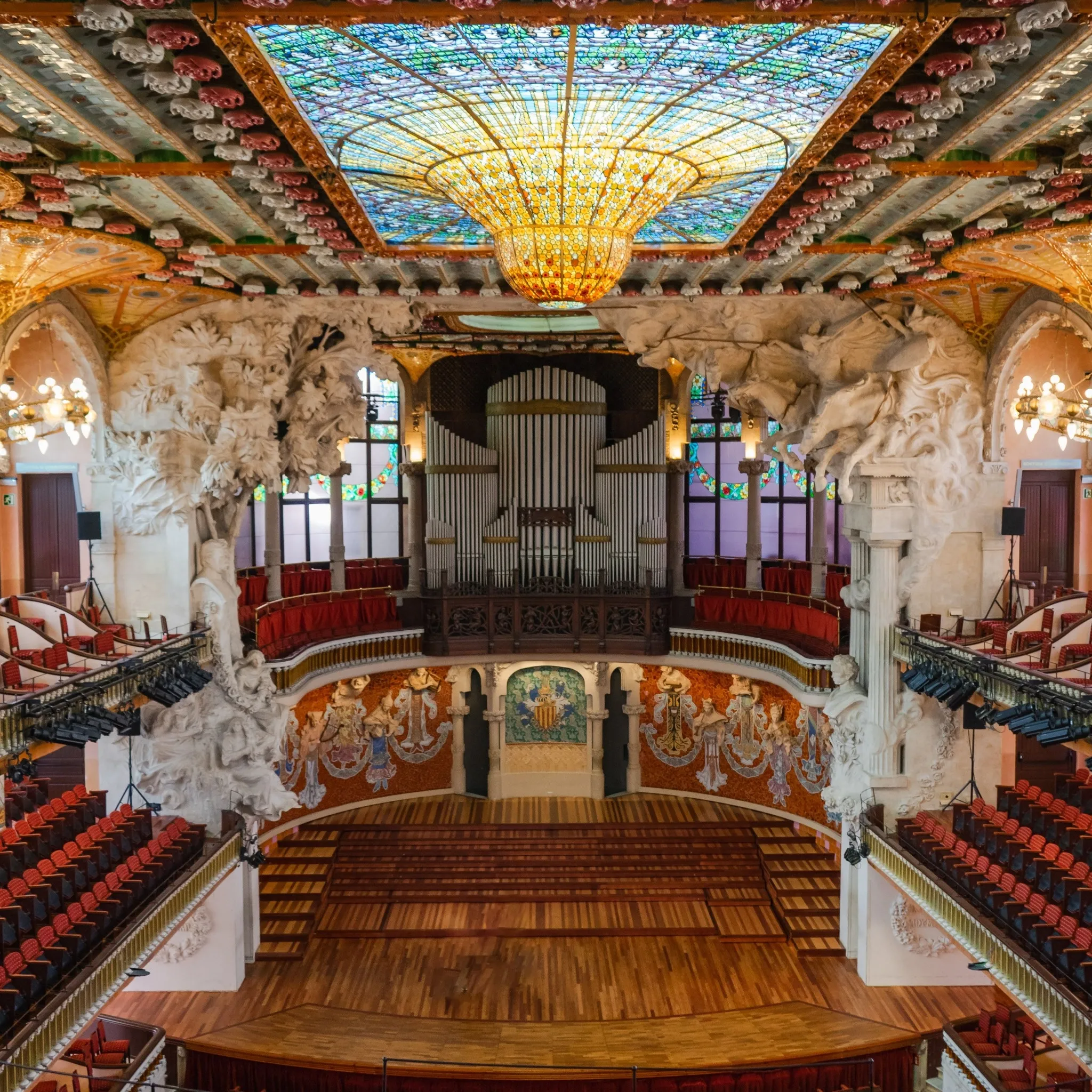
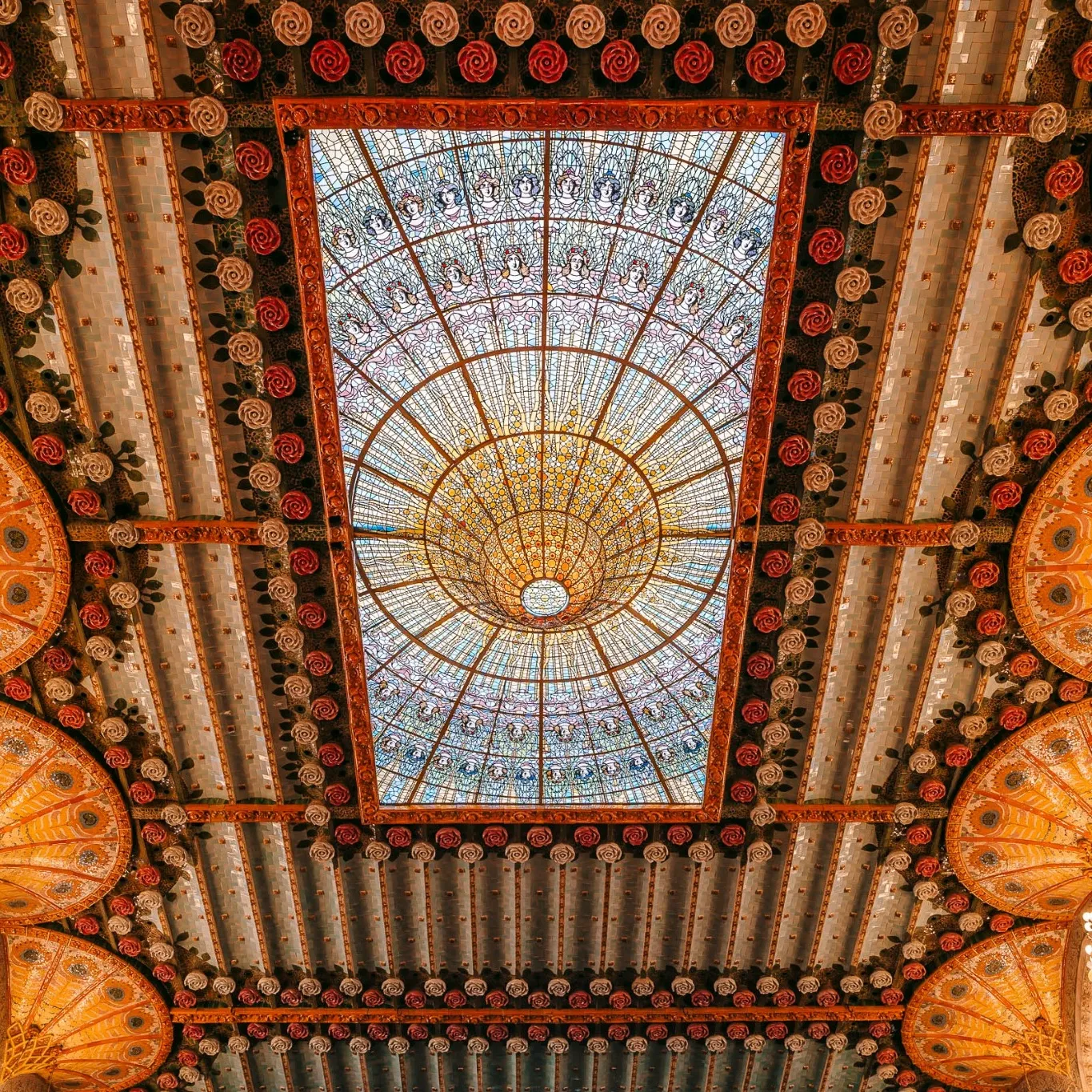
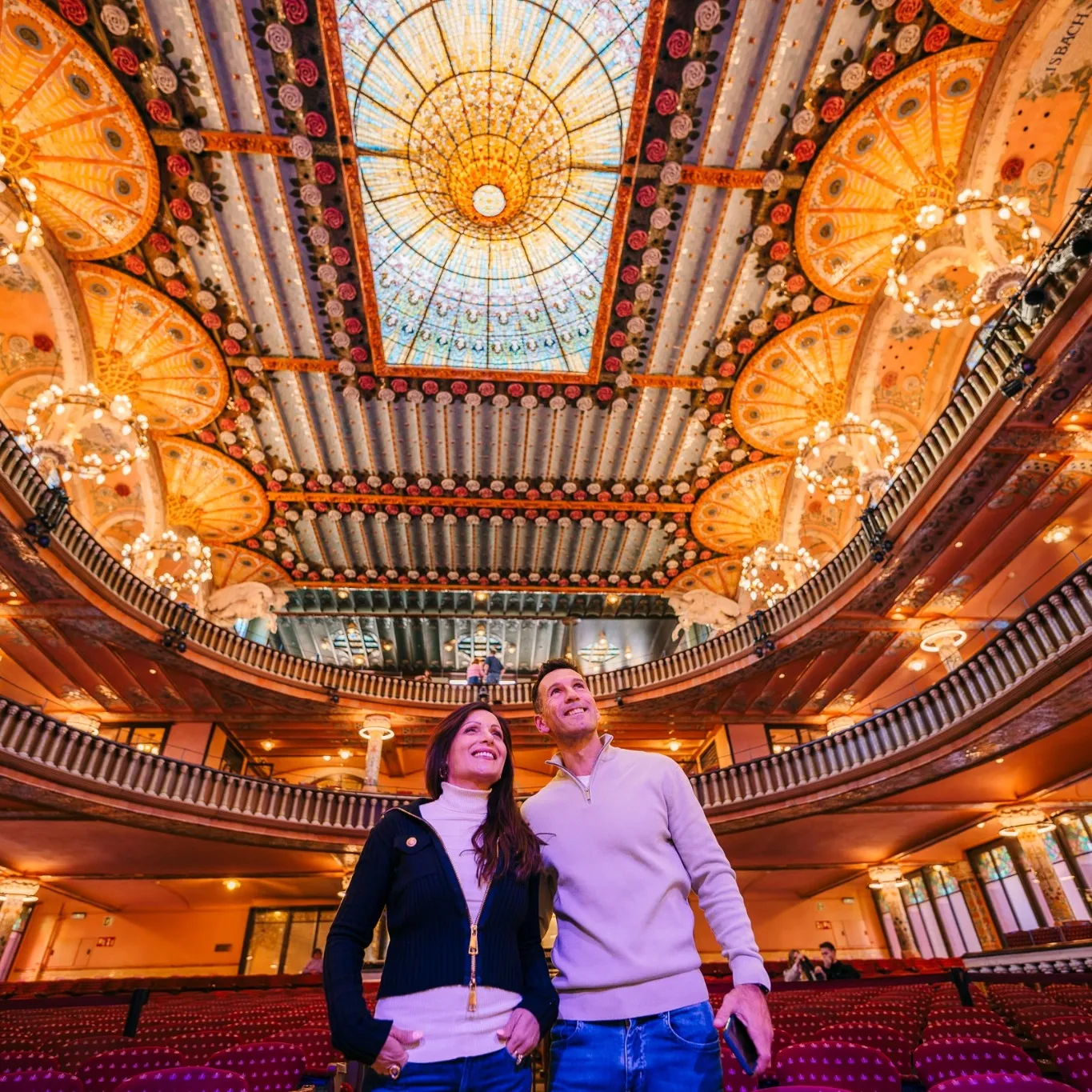
The interior of the Palau de la Música Catalana is one of the most remarkable spaces in Barcelona’s Modernista heritage. Its most iconic feature is the vast central stained-glass skylight, designed by Antoni Rigalt i Blanch, a spectacular inverted dome that floods the concert hall with natural light, creating an incomparable atmosphere.
The muses and the musical symbolism of the stage
Flanking the proscenium arch, traditional folk music and classical music are represented respectively by the bust of Josep Anselm Clavé, the pioneer of the Catalan choral movement, and by the figure of Beethoven, embodying the great European musical tradition. This duality mirrors one of the founding ideals of the Orfeó Català: bridging popular culture with the masterworks of the universal repertoire. The setting is completed by the renowned Muses, sculpted by Eusebi Arnau, which emerge from a mosaic backdrop created by Mario Maragliano and Lluís Bru, depicted playing instruments from various cultures and eras to evoke the universal nature of music.
A total work of art of Catalan Modernisme
When designing the building, Domènech i Montaner collaborated with some of the era’s foremost sculptors, mosaicists and artisans. The result is a true total work of art, in which architecture, sculpture, mosaics, stained glass and decorative arts blend harmoniously, making the Palau one of the supreme achievements of Catalan Modernisme and Barcelona’s architectural heritage.
The Palau de la Música Catalana, UNESCO World Heritage
The Palau de la Música Catalana was declared a Historical-Artistic Monument in 1971. Along with the Sant Pau Modernista Complex, it stands among the most representative works of Lluís Domènech i Montaner, recognised by UNESCO as a World Heritage Site since 1997, an accolade that attests to its exceptional significance within Barcelona’s Modernista architecture.
