

 Español
  Català
  Français
  Italiano
  Portuguese
  Deutsch
  中文
中文  한국어
한국어  日本語
日本語 
Catalan Modernisme
Modernisme was a cultural, artistic, social and political movement that developed in Europe during the final decade of the nineteenth century and the early years of the twentieth century. In Catalonia, Modernisme was more than simply a version of French and Belgian Art Nouveau, English Liberty style, the Viennese Secession or German Jugendstil. Although the influence of Europe on Catalan Modernisme is undeniable, its development is unique and distinctive.
Catalonia and Catalan Modernisme
Catalan Modernisme was present in all the arts: painting, sculpture, music, theatre, literature and, of course, architecture. It represented a break with traditional academicism, which imitated the styles of the past, and sought a new artistic language. In a way, the movement reflects a “fin de siècle” attitude that pursued artistic modernity as a means of bringing the whole country up to date.
The intellectuals of the time clearly promoted the desire to be “modern”, encouraging cultural and social renewal: “To new times, new forms of art.” (Jaume Brossa, L'Avenç, 1892). For this reason, the name Modernisme was adopted to designate the movement.
It was a period of intense economic progress in Catalonia, especially in Barcelona. Capital repatriated from the colonies lost in 1898 in Cuba and the Philippines made it possible to undertake important initiatives in industry and real estate. The industrialisation of Barcelona created a new emerging social class: a newly wealthy bourgeoisie eager to modernise and build an autonomous country. During those years, Catalanism was strengthened throughout Catalonia, spanning the entire political spectrum from bourgeois parties to the working classes. Historians consider this period one of the most powerful impulses in the history of Catalonia, through which the country fully integrated into Europe.

Catalan Architectural Modernisme
From an architectural point of view, the emergence of Catalan Modernisme was made possible by Barcelona’s status as capital and by the construction of the Eixample district. The fact that Barcelona could no longer be confined within its 19th-century city walls forced it to expand into a new city area: the Eixample, designed by the engineer Ildefons Cerdà. Barcelona, a city undergoing rapid growth, offered enormous possibilities for construction and for the development of a new architecture that was modern, eclectic and innovative. For this reason, Barcelona is considered the world capital of architectural Modernisme.
In Barcelona, streets were paved, a sewer network was built, public lighting was introduced, trams were electrified, construction of the metro began and, as a consequence of urban expansion, the surrounding towns were annexed (Gràcia, Sant Gervasi de Cassoles, Les Corts, Sants, Sant Martí de Provençals, Sant Andreu del Palomar, Horta, Sarrià, etc.).
Historians date the beginning of an early phase of Modernisme to the 1888 Universal Exhibition held in Barcelona. This first stage adopted an eclectic approach that clearly leaned towards medieval-inspired models. During this decade the stylistic shift became consolidated, and by 1900 Modernisme had become widely established in Barcelona and began to spread throughout Catalonia in all its splendour.
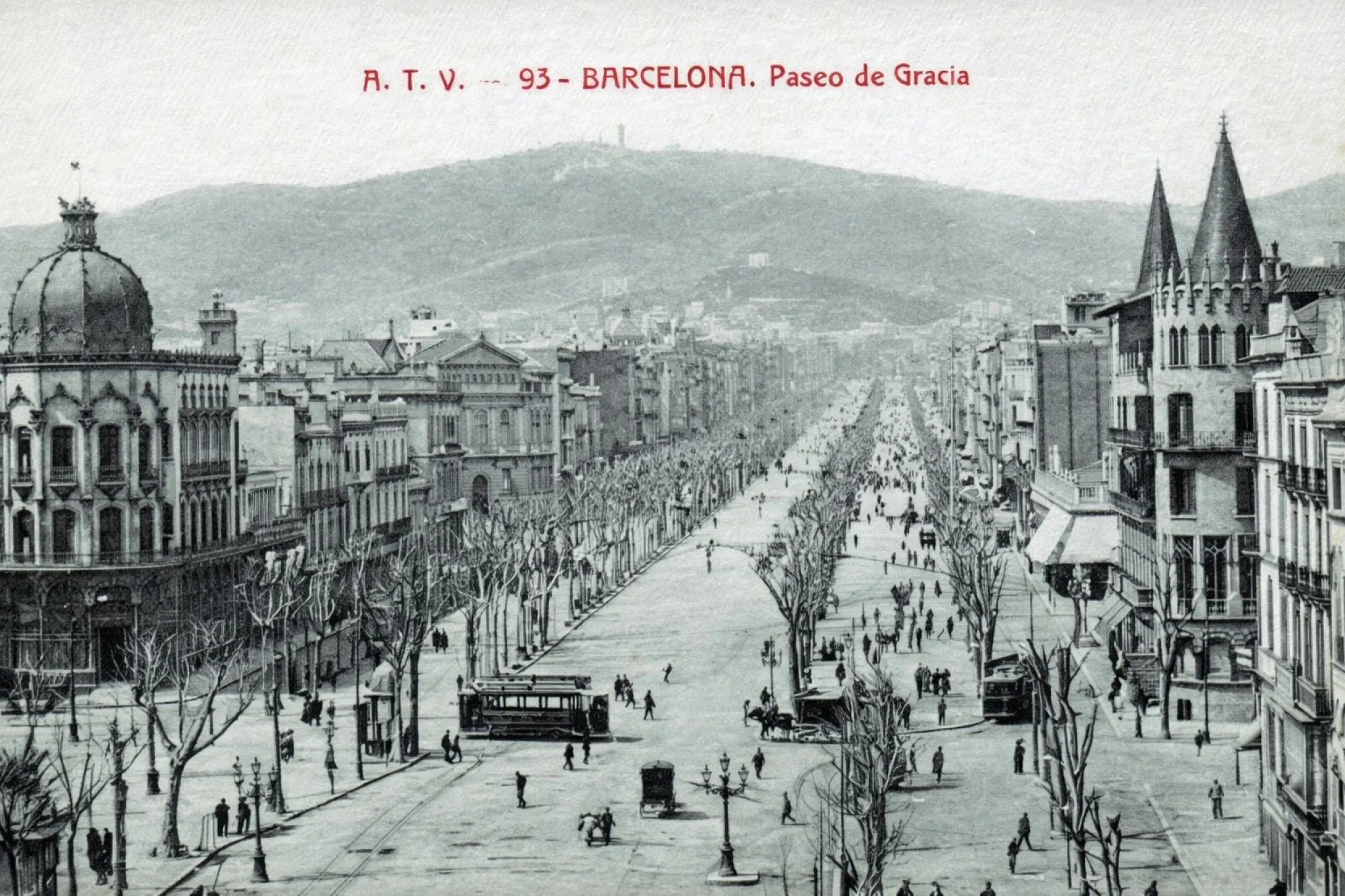
By 1900, Passeig de Gràcia had become the most important avenue in the city, where emblematic buildings began to be constructed and where the finest theatres, cinemas, shops, restaurants and cafés were established. It was also the place where the wealthiest and most enterprising bourgeois families chose to build their homes and, in a race of boldness and display, commissioned projects from the most prestigious architects of the time in order to be modern and distinguished.
It was in this context that the so-called Block of Discord (“Mansana de la Discòrdia” in Catalan) emerged, probably the most outstanding example of this singular and eclectic Modernisme on Passeig de Gràcia: Josep Puig i Cadafalch (1867-1956) with Casa Amatller (1898-1900), Lluís Domènech i Montaner (1850-1923) with Casa Lleó Morera (1904-1905) and Antoni Gaudí (1852-1926) with Casa Batlló (1904-1906). In many ways they embodied the role of the modern architects, the star architects of their time.
However, there were many other architects who, with varying degrees of fame, played a key role in promoting the new art and shaping the character of the city and of Catalonia, such as Antoni Rovira i Rabassa (1845-1919), Pere Falqués (1850-1916), Joaquim Bassegoda i Amigó (1854-1938), Manuel Comas i Thos (1855-1914), Enric Sagnier i Vilavecchia (1858-1931), Josep Doménech Estapá (1858-1917), Lluís Muncunill i Parellada (1868-1931), Joan Rubió i Bellver (1871-1952), Salvador Valeri i Pupurull (1873-1954) and Manuel Joaquim Raspall i Mayol (1877-1937), among others.
What these architects probably share is the importance they give to decorative elements. Their work often develops within traditional building typologies, although Gaudí stands out by proposing new structural systems.
Architectural Modernisme is generally considered not to have a single defined style. Under the idea of creating buildings as total works of art, the aim was to achieve the highest artistic quality in every detail, however small, with a strong emphasis on richly decorated and colourful façades.
At the same time, decorative ceramics, mosaic, paving, plasterwork, stonework, sgraffito, stained glass, ironwork and mural decoration were all essential elements of Modernisme.
Across Catalonia there was a strong craft tradition that enabled the revival of many forgotten techniques. Combined with industrial advances, this led to the extensive production of decorative elements.
There are outstanding examples of private residential architecture throughout the territory. In terms of public architecture, two exceptional examples stand out: the Palau de la Música (1905-1908) and the Hospital de Sant Pau (1905-1911), where Lluís Domènech i Montaner brought together the most distinctive elements of Catalan Modernisme.
Decline and revival
It should be noted that, in general, the population of those years reacted against everything that Modernisme represented. Humour magazines of the time ridiculed the new architecture with jokes and comments. Casa Batlló was nicknamed the “house of bones”, while Casa Milà was compared to a futuristic zeppelin parking garage or even to an Easter cake. The “Block of Discord” and the façades of the most emblematic buildings of Modernisme were also the target of public mockery.
Noucentisme gained momentum as the new artistic movement from 1906 onwards, and Modernisme fell into decline. Changing tastes and the absence of laws protecting heritage led to the loss of many Modernisme masterpieces.
Many years passed before figures such as Salvador Dalí, the rationalist architects of the GATCPAC, Le Corbusier, J. J. Sweney, Nikolaus Pevsner, G. R. Collins, R. Pane or Bruno Zevi, among others, began to promote an international recognition of Modernisme and its architects, especially Antoni Gaudí.
Over time, the heritage of Modernisme has been restored, preserved and enhanced in Barcelona and throughout Catalonia.
Finally, the Modernisme discussed here should not be confused with an artistic movement that developed in Europe and America after the First World War and is known by the English term Modernism, also called the International Style. To avoid confusion, the term Catalan Modernisme should not be translated as Modernism.