

 Español
  Català
  Français
  Italiano
  Portuguese
  Deutsch
  中文
中文  한국어
한국어  日本語
日本語 
Discover one of Gaudí’s greatest masterpieces.
History and context of the Güell Colony
The Crypt of the Church of the Güell Colony is one of Antoni Gaudí’s most innovative works and represents a key precursor to the architectural solutions found in his work.
The Güell Colony was founded by Eusebi Güell in 1890 in Santa Coloma de Cervelló, after he relocated the El Vapor Vell textile factory there from Sants. Specialising in the production of corduroy and velvet, the factory stood out for its use of a coal-fired steam engine, an advanced technology that was uncommon among Catalan industrial colonies at the time. Its design is attributed to Ferran Alsina, who promoted various technical and organisational innovations.
A workers’ colony developed around the factory complex, based on the urban development project by architects Francesc Berenguer i Mestres and Joan Rubió i Bellver, disciples and collaborators of Antoni Gaudí. The colony included housing and various facilities intended to improve the workers’ living conditions, including a school, cooperative, cultural centre, dispensary, sports ground, theatre society and library.
The commission for the church
As regards religious worship, in 1898 Eusebi Güell commissioned Antoni Gaudí to build a church at the top of a hill so that it would be visible from any point in the colony.
The polyfunicular model: Gaudí’s laboratory
Before construction began on 4 October 1908, Gaudí carried out numerous preliminary studies and developed an innovative system of structural calculation. To do so, he created a polyfunicular model, an experimental tool made from fabric, cords and small weights that enabled him to study the behaviour of forces and determine architectural forms directly dictated by the static equilibrium of the planned building.
This system enabled him to test structural and formal solutions that would become fundamental to his architectural career. For this reason, the Crypt of the Güell Colony has often been considered Gaudí’s experimental workshop, as it was here that he tested various construction innovations that he would later apply and perfect in other projects, particularly at the Basilica of the Sagrada Família.
An unfinished work
The project was left unfinished when the Güell family stopped financing the work in October 1914, as had also happened with Park Güell. Eusebi Güell’s deteriorating health led to a gradual transfer of responsibilities to his sons, who considered both projects economically unviable. Only the lower nave was completed at the Colony. It was blessed for worship in 1915 and became popularly known as the Crypt of the Güell Colony.
Structural and geometric innovations.
The Crypt blends perfectly into its surroundings, taking advantage of the considerable slope of the terrain. In this work, Gaudí provides a true lesson in structure and geometry to create a building of extraordinary sculptural expressiveness.
Among the main innovations are hyperbolic paraboloid surfaces, popularly known as saddle shapes, used to cover the vaults connecting the arches of the portico.
The columns, materials and light
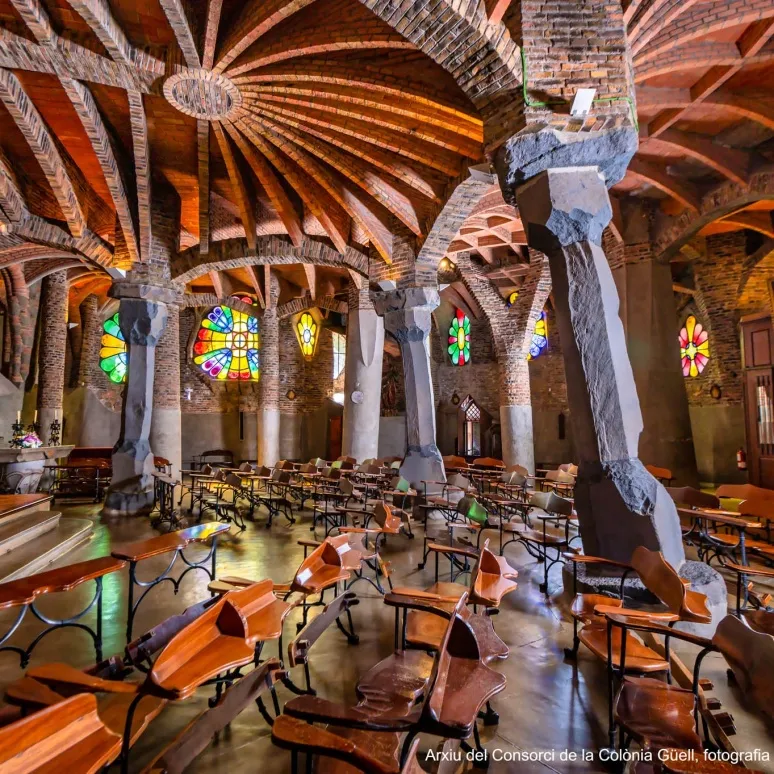
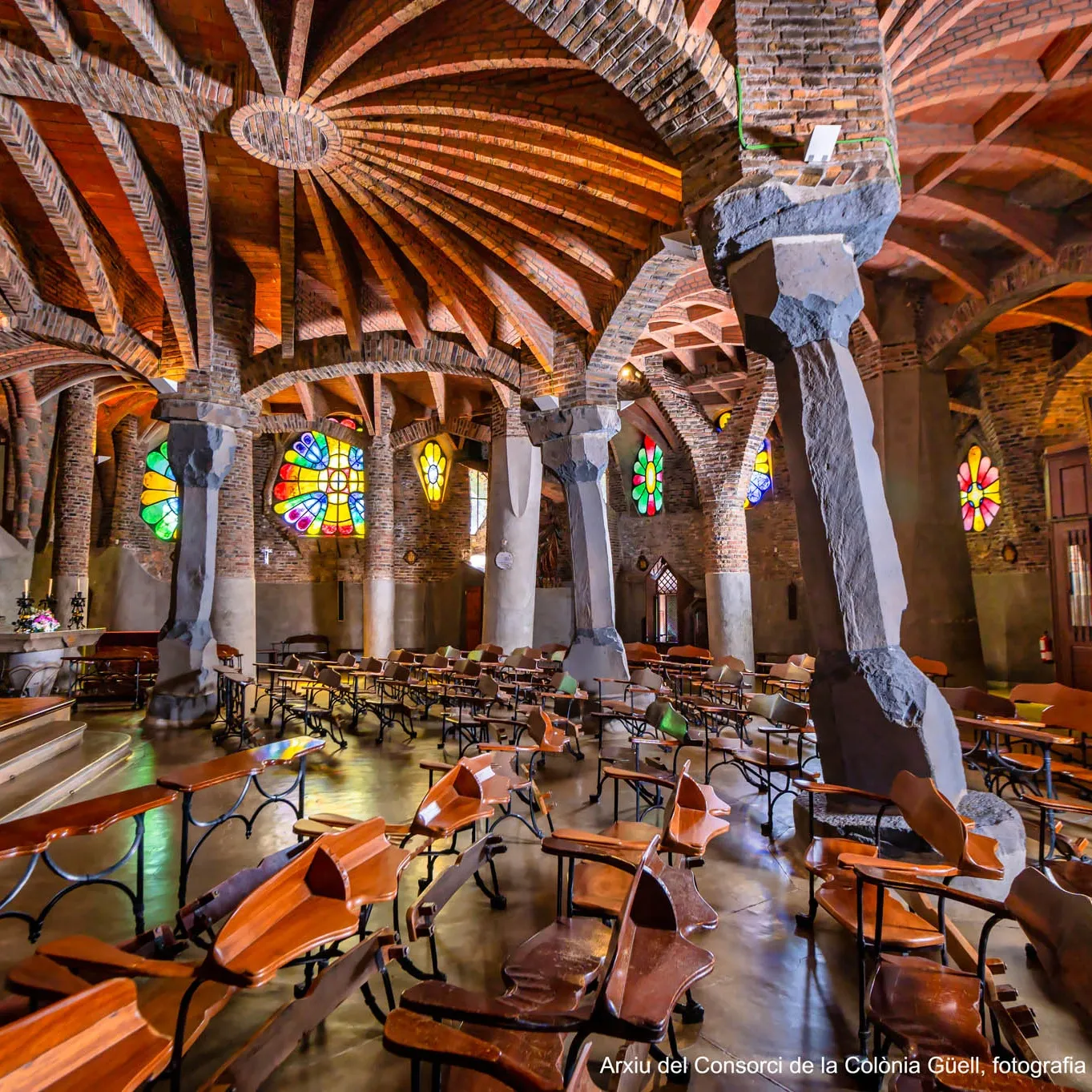
The columns of the portico, built from basalt and brick, blend in with the pine trees surrounding the building. They are inclined and bear a strong resemblance to those found at Park Güell, built during the same period.
Inside, brick is prominently used in the columns, arches and vaults, while the central columns leading towards the altar are made from roughly hewn blocks of basalt. The stained-glass windows in the shape of butterflies are also particularly striking, filtering the light and creating a distinctive atmosphere.
As in nature, no two elements are alike: every column and every vault is different, reinforcing the organic character of the work.
Heritage recognition and legacy
The Crypt of the Church of the Güell Colony is considered a key work for understanding the architectural evolution of Antoni Gaudí. The construction, structural and formal solutions tested in this building had a decisive influence on the architect’s later projects.
The Crypt of the Church of the Güell Colony has been designated a Historic-Artistic Monument (BCIN category) since 1969 and was inscribed on the UNESCO World Heritage List in 2005 as part of the Works of Antoni Gaudí.
