

 Español
  Català
  Français
  Italiano
  Portuguese
  Deutsch
  中文
中文  한국어
한국어  日本語
日本語 
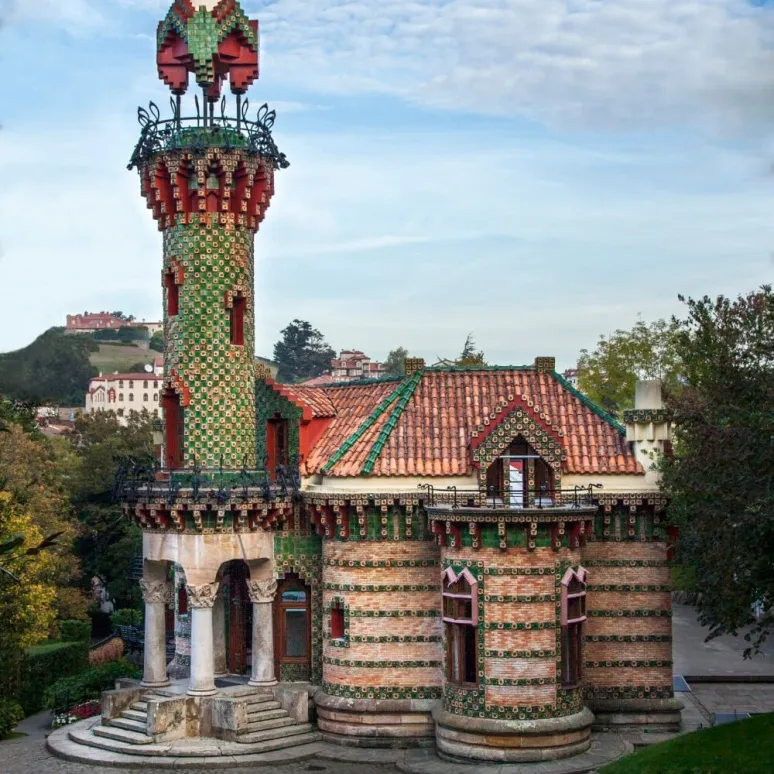
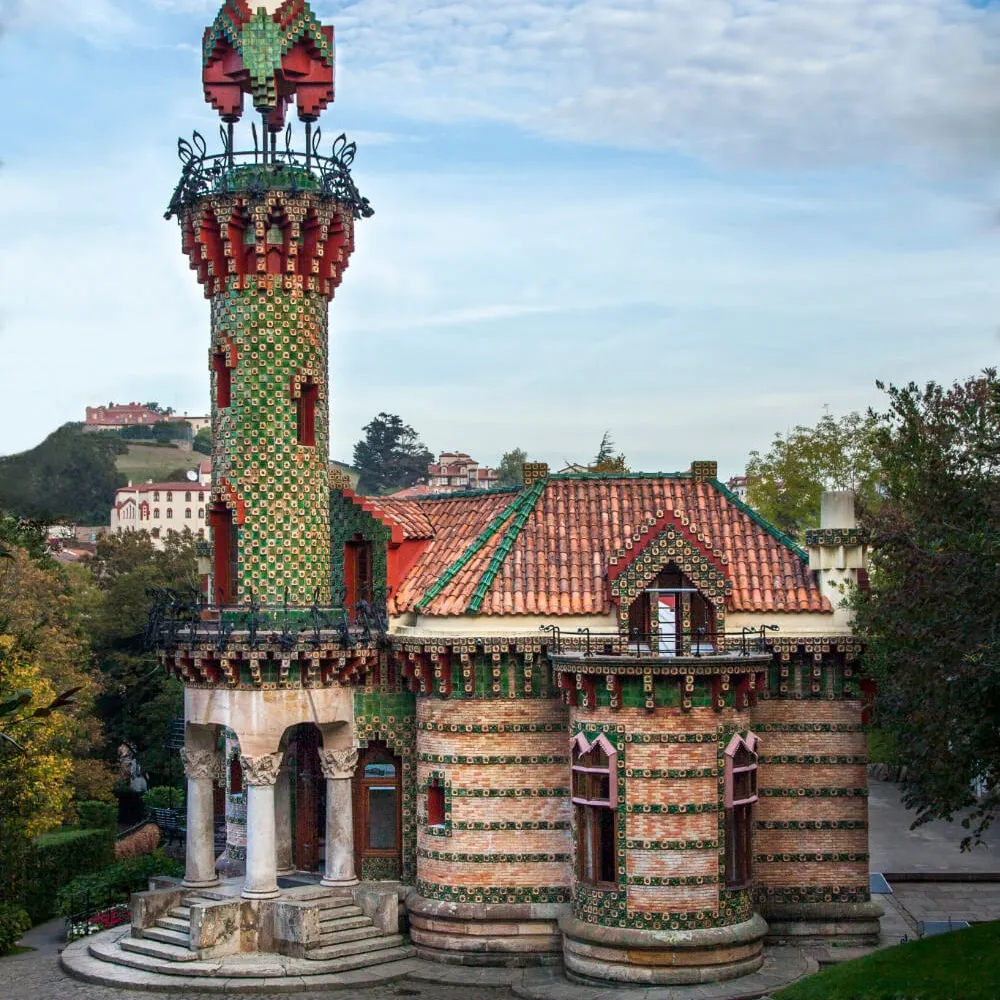
Discover one of Gaudí’s greatest masterpieces.
El Capricho
Villa Quijano, popularly known as «El Capricho», is an early work by Antoni Gaudí built in Comillas (Cantabria) as a residence for Máximo Díaz de Quijano, an indiano linked to the Marquis of Comillas, Antonio López y López. The project belongs to the early years of Gaudí’s career and is contemporary with Casa Vicens, with which it shares formal solutions, an expressive use of materials and a strong symbolic dimension.
Year of construction
1883 - 1885
Location
Bo. Sobrellano s/n 39520 Comillas, Cantabria
History of El Capricho
The commission is set within the context of the Sobrellano Palace, a work by Joan Martorell, the architect with whom Gaudí collaborated. This relationship helped him receive the project for a villa located just a few metres from the palace, on a narrow, sloping plot, a circumstance that shaped the form and organisation of the building.
The building has an irregular floor plan and is organised over three levels, basement, main floor and attic. On the exterior, the stone base contrasts with the yellow and red bricks of the walls, combined with bands of glazed ceramic. Gaudí uses only two ceramic relief motifs, the sunflower and its leaf, repeated and combined to create a unified decorative programme of great symbolic power, linked to light, growth and the cycle of life. This ornamental concept also appears in Casa Vicens.
One of the most distinctive elements of «El Capricho» is its cylindrical minaret-like tower, which dominates the building’s silhouette and accentuates its Orientalising character. This tower reflects Gaudí’s early interest in Islamic and Mediterranean architecture, freely integrated into his personal language.
The intense colour and fanciful forms of the ensemble gave rise to the name by which the building is popularly known: «El Capricho».
Máximo Díaz de Quijano died in 1885, the same year the works were completed. He did live in the residence, although only for a very brief period. The building was designed as a fully habitable residence, linked to his needs and way of life. In this sense, the work can be read in relation to Máximo’s personal interests, as a pianist, writer and lover of botany, which are symbolically reflected in the architecture and in its dialogue with music and nature.
«El Capricho» is the first burst of Gaudí’s genius, where fantasy becomes architecture and nature becomes a constructive language.
The building was declared a Historic-Artistic Monument of national interest in 1969.
