

 Español
  Català
  Français
  Italiano
  Portuguese
  Deutsch
  中文
中文  한국어
한국어  日本語
日本語 
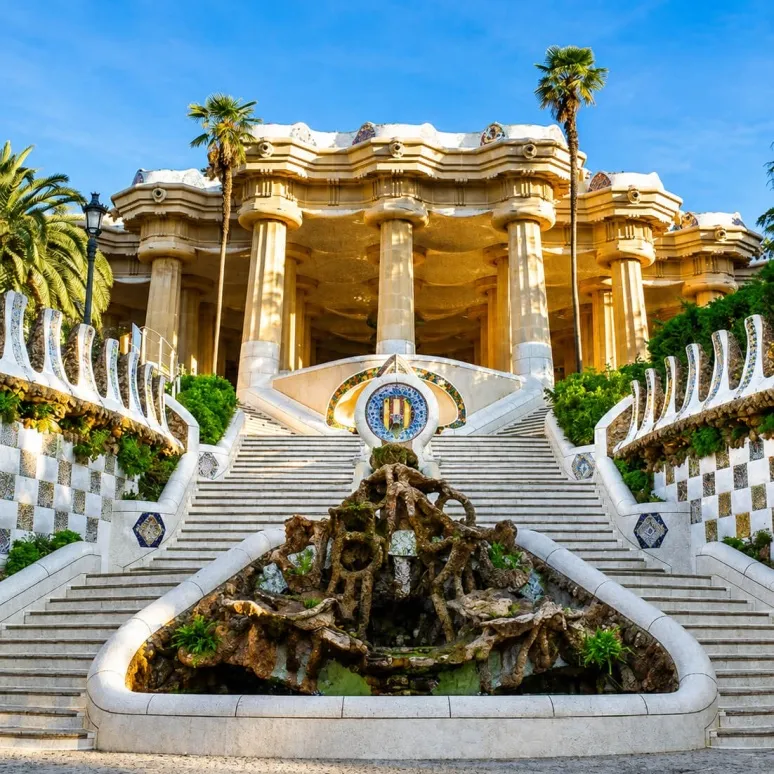
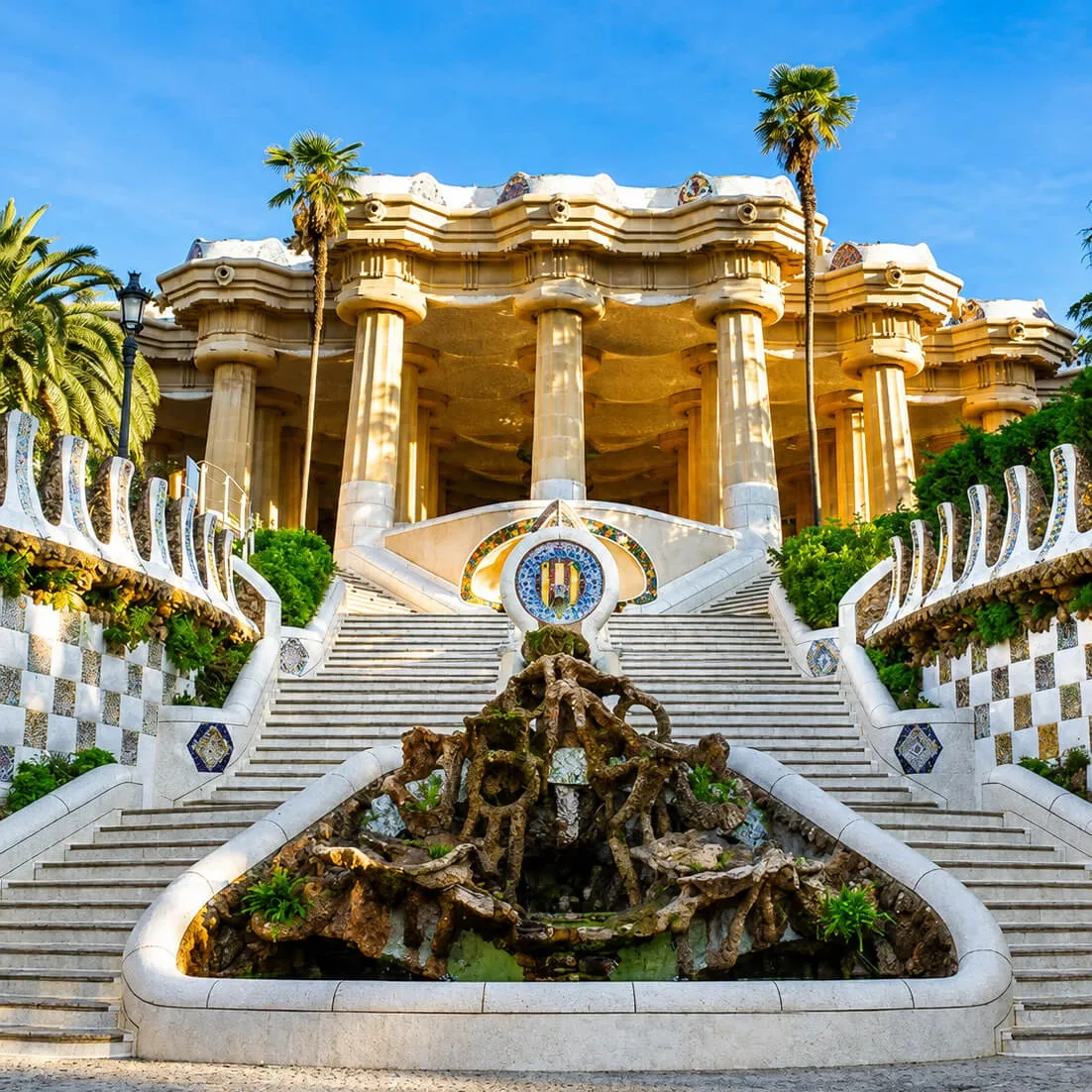
Discover one of Gaudí’s greatest masterpieces.
Park Güell
Park Güell is one of Antoni Gaudí's mature works and one of the finest examples of Modernist architecture in Barcelona. Commissioned by the businessman Eusebi Güell and designed in the northern part of the city, it was originally conceived as a private residential development, although it eventually became a public park, a function it still fulfils today.
The site covers approximately 15 hectares and represents an exceptional synthesis of architecture, engineering, nature and artistic expression. Declared a UNESCO World Heritage Site, Park Güell is one of Gaudí's most visited monuments in Barcelona.
Year of construction
1900 - 1914
Location
Carrer d’Olot, s/n, Barcelona
History of Park Güell
The original Park Güell project envisaged the construction of sixty plots with detached houses surrounded by gardens. Although only two of the planned houses were ever built, the site retains the main communal spaces designed by Gaudí: the entrance pavilions, the grand staircase, the Hypostyle Room and the square with its famous sinuous trencadís bench.
Güell was an important patron of Gaudí and enabled the development of some of his most innovative ideas. Their close collaboration led to other projects of great importance to the architect, such as Palau Güell and the Crypt of Colònia Güell.
Due to the limited success of the project, construction work stopped in 1914. Following the death of Eusebi Güell in 1918, the estate was acquired by Barcelona City Council, which opened it to the public as an urban park in 1923.
In 1969, the Park Güell site in Barcelona was declared a Historic-Artistic Monument (BCIN), and in 1984 it was inscribed on the UNESCO World Heritage List as part of the works of Gaudí.
The architecture of Park Güell
The main entrance to Park Güell is flanked by two organically shaped pavilions, clad in polychrome ceramic trencadís. One of them, intended as the caretaker's residence, is crowned by a mushroom-shaped dome, while the other features a tower topped by a four-armed cross, a recurring symbolic element in Gaudí's work that also appears in buildings such as Torre Bellesguard.
The monumental staircase, which provides access to the park's main architectural spaces, leads to the Hypostyle Room, conceived as the market for the residential development. It consists of eighty-six Neo-Doric columns incorporating a sophisticated system for collecting and channelling rainwater into an underground cistern. Along this route stands the famous sculptural dragon, which acts as an outlet for excess water from the cistern and has become one of the most prominent symbols of Park Güell and Barcelona.
Nature Square at Park Güell
Located above the Hypostyle Room, Nature Square at Park Güell was conceived as a large meeting space for the residents of the development. It is bordered by the famous undulating trencadís bench, made from prefabricated modules and featuring an anatomical backrest adapted to the position of the human body.
The bench is clad in polychrome ceramic trencadís, with a free and expressive decorative design created in collaboration with Josep Maria Jujol, lending it remarkable chromatic and formal freedom. The square's sandy surface allows water to filter down into the cistern below, incorporating principles of functionality and sustainability into water management.
Nature and landscape at Park Güell
For the design of Park Güell, Gaudí studied the mountain's topography with great precision and devised a system of viaducts and paths adapted to the terrain and existing vegetation, achieving a harmonious integration of architecture into the landscape. In these viaducts, Gaudí incorporated inclined columns, a solution that the architect later used in the Crypt of Colònia Güell.
At the same time, he also worked on the planting scheme, preserving native flora and introducing Mediterranean species such as carob trees, palm trees, wisteria and rosemary, thereby reinforcing the park's integration into its natural surroundings.
In 1906, Gaudí purchased the Park Güell show house, built in 1902 by his friend and collaborator Francesc Berenguer as a model for the residential project. Gaudí made this house his home, living there with his father and niece while remaining fully immersed in the development of the park. Today, the building houses the Gaudí House Museum, where furniture, personal belongings and pieces designed by the architect are preserved. The museum offers an insight into the architect's everyday life during the twenty years he lived in the house, a period in which he worked on some of his most important projects, such as Casa Milà and the Sagrada Familia.
