

 Español
  Català
  Français
  Italiano
  Portuguese
  Deutsch
  中文
中文  한국어
한국어  日本語
日本語 
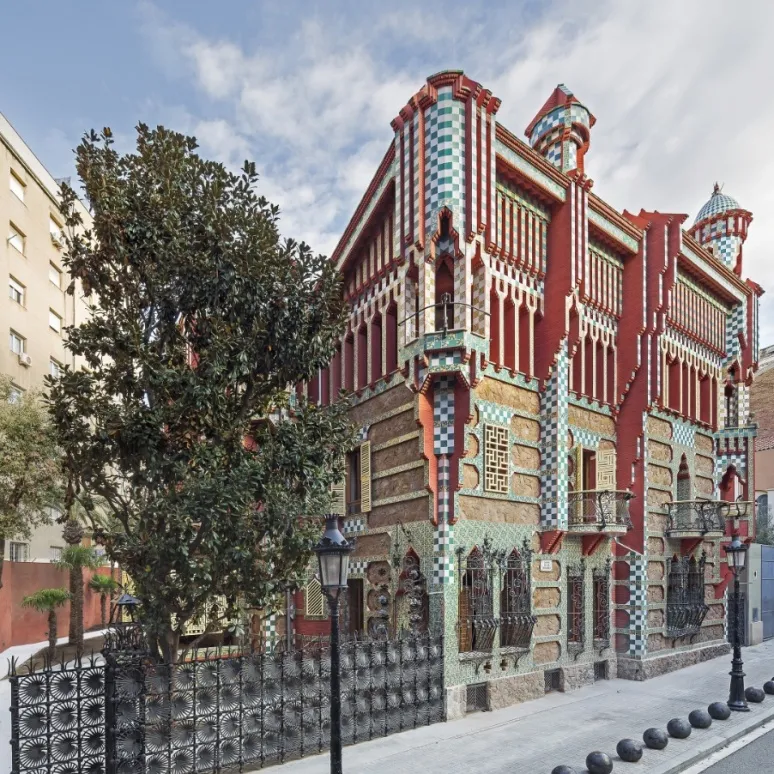
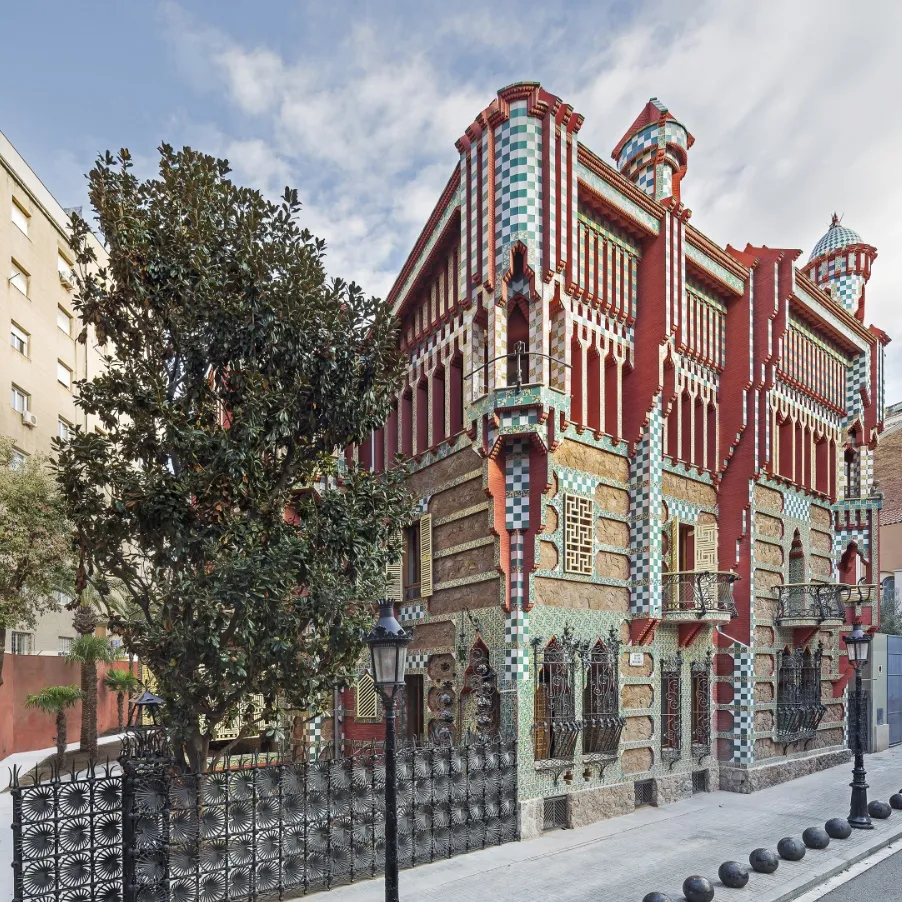
Discover one of Gaudí’s greatest masterpieces.
Casa Vicens
Casa Vicens is the first house built by Antoni Gaudí, commissioned by Manel Vicens i Montaner, a stockbroker, as a family summer residence in the former town of Gràcia, which would be annexed to Barcelona fourteen years later.
Year of construction
1883 - 1885
Location
Carrer de les Carolines, 20-26, 08012 Barcelona
History of Casa Vicens
The building belongs to Gaudí’s first creative period, contemporary to «El Capricho», and shares with it formal and material solutions of great visual and aesthetic impact, reflecting the taste of the time for decorative elements inspired by distant and exotic places, a trend that would later spread throughout many Modernisme interiors.
In this project, Gaudí had the opportunity to fully display his technical abilities, knowledge and creativity. The details of both the interior and exterior of the building reveal the influence of Oriental, Islamic and Mudéjar architecture. It was at Casa Vicens that the architect first used structural, decorative and symbolic elements that would later define his architectural language and foreshadow his later works. The building is considered a manifesto of his talent, visible in his mastery of materials and techniques such as ceramics, ironwork and prefabricated elements.
Externally, the exposed stone base contrasts with the upper part of the building, finished with exposed brick and ceramic tiles. The exterior tile becomes a central element in completing the ornamental process, creating an exceptional effect of variety, movement and colour achieved by Gaudí from a single model. The architect designed a single piece: a smooth tile depicting three flowers, two buds and several leaves of the carnation flower, conceived so that it could be combined in every direction. This system created authentic surfaces resembling interwoven flowering fields at a reduced cost and with remarkable visual richness. Gaudí combined it with two other standard-production tiles, one white and one green, achieving an ensemble of extraordinary chromatic and ornamental effect.
On the façade facing the garden, particular attention should be paid to the pivoting shutters with geometric latticework inspired by Oriental forms, which allowed the regulation of light entry and air circulation, as well as to the fountain placed in front of the gallery, designed to provide freshness throughout the room.
Nature is present throughout the house and Gaudí used it as a source of inspiration for the exterior wrought-iron fence. Dwarf fan palms were abundant on the estate grounds, and the fence features a repeated motif of buds among the leaves of this plant.
The decorative richness continues indoors. Gaudí employed a wide range of decorative techniques, including Roman mosaics on the floors, mural painting, stucco and sgraffito work, displayed through ornamental repertoires featuring flora and fauna motifs (sparrows, hummingbirds, flamingos, magpies, cranes, grapes, cherries, olive trees, passion flowers and strawberry tree leaves), with extraordinary formal and chromatic richness.
The smoking room is one of the most singular spaces in the house, with a clear Mudéjar influence visible in the ceiling of polychrome plaster muqarnas. The walls are decorated with cardboard tiles made from papier-mâché, a system developed by Hermenegild Miralles, which imitates ceramic tiles through a single embossed piece repeated continuously, blurring the perception of spatial boundaries. Miralles later patented this system, suggesting previous joint experimentation with Gaudí. This material was also used by Gaudí in other rooms of the house because of its advantages: lightness, low cost, durability, ease of installation and strong visual impact.
At Casa Vicens, Gaudí created his first accessible rooftop, conceived as a space for escape and contemplation, an authentic viewpoint over nineteenth-century Barcelona. The towers and domes located at the different corners of the building reveal the influence of Islamic and Oriental architecture.
Despite the loss of the original garden and the waterfall designed by Gaudí, Casa Vicens remains a manifesto of Gaudí’s youthful, innovative and ornamental spirit.
Casa Vicens has been declared a Historic-Artistic Monument (BCIN category) since 1969 and was inscribed on the UNESCO World Heritage List in 2005 as part of the Works of Antoni Gaudí.
